Oregon Mediation Association

Promoting collaborative and equity-informed conflict resolution.

  • About OMA
    • – Board of Directors & OMA Staff 2026 –
    • Our Board Values
    • History and Milestones
    • Standards of Practice
    • Standards of Practice Update
    • Frequently Asked Questions
  • Join
    • Join Now
    • Membership Benefits
    • Membership Levels
    • Become a Mediator
    • Job & Volunteer Opportunities
  • Member Log-In
  • Find a Mediator
    • Mediator Directory
    • CDRCs
  • Support
    • Donate
  • Calendar
  • News and Events
    • Blog
  • Contact
    • Website Privacy Policy
You are here: Home / Archives for ormediate

The Self-Care Series: Start the Day Right

June 19, 2019 by ormediate

A great day today starts … yesterday. How you spend your evenings has everything to do with how you feel when you wake up in the morning. That’s why over the last couple of months, the Self-Care Series has focused on the habits of eating dinner early and light and going to bed early. Together, these two habits set you up to sleep well so you can wake up in the morning feeling energized and start the day right.

Before we get into the details of morning routine, let’s review these key evening habits:

  • Earlier Lighter Dinner: Eat a light, simple-to-digest meal by 6pm, so your body will digest your food completely before you go to bed.
  • Early to Bed: After dinner, take a walk or do some active chores. Turn off screens at least an hour before bedtime. Aim to close your eyes by 10 p.m.

Once established, these habits will make it much easier for you to sleep well, wake up early and enjoy a nourishing and energizing morning routine.

Morning Routine Basics

Being intentional about how you start your day is, as they say, “a thing.” You can emulate the habits of Richard Branson, Benjamin Franklin, or any number of other famous people (including Oprah Winfrey) who all have reported a strong commitment to starting the day right.

Many of the popular morning practices you may read about or try are rooted in ancient wisdom. My field of interest is Ayurveda – India’s ancient system for health and healing. Ayurveda teaches us to live in rhythm with nature. Starting your day aligned with nature might include:

  • Greeting the day and setting an intention
  • Drinking warm water to stimulate your internal systems
  • Invigorating your body with movement.

Author and teacher Ananta Ripa Ajmera explains in her book, The Ayurveda Way, “Starting your day in an inspiring and invigorating way profoundly impacts your overall health. Ayurveda recognizes the power and potential of morning practices to teach you to truly take your health and life into your own hands.”

Let’s look at how you can proactively create a great day – and a healthy life – with these three simple habits.

Greet the Day

The early morning hours are considered by many traditions to be an especially sacred time. Regardless of your religious or spiritual beliefs, the morning time is special. It is quiet. The energy of this time of day is clear, pure, and peaceful. This is a great time to:

  • Set your intention for the day, meditate, or pray
  • Rehearse or visualize how you want your day to unfold
  • Practice gratitude

Your practices could take 30 seconds or 30 minutes. The number of ways in which you greet the day is infinite and totally customizable to your personality, time, and interests. Choose anything that is meaningful to you.

Drink Warm Water

A glass of room temperature or warm water with lemon first thing in the morning will gently stimulate your stomach, liver, gallbladder, and lymphatic system. According to Lauren Gernady from the Kripalu School of Ayurveda, “Drinking warm water in the morning provides a gentle flush for the whole system while also stimulating peristalsis.” The downward flushing pressure of the water helps with elimination, so you can get rid of yesterday’s waste and start today with a clean slate.

The habit of drinking any amount of water first thing in the morning is new for many people. It’s fine to start slow with six to eight ounces, and gradually work up to sixteen or more ounces of water every morning.

Move Your Body

Breath – or prana as it is called in yoga and Ayurveda – is your source of life. Without breath there is no life. A lack of movement invites stagnation and disease into your body. Welcoming deep breaths and full-body movement first thing in the morning tells your whole self, “I’m alive and ready to live fully today!”

You may have the habit of a morning workout. If so, you know how great it feels to get your blood pumping first thing in the morning. It breaks up stagnation, brings fresh air into your lungs, and clears the fog from your brain.

If doing a full workout in the morning is not appealing or feasible, it’s still important to move your body before you eat, caffeinate, and start engaging with the world. You could do yoga or dance, go for a walk, do full-body stretches, or any other body-centered movement practice.

Create a Morning Routine with Small Steps

Scientists who study human behavior and habits help us understand how to create habits that last. The most important strategy that I teach my clients and course members is the strategy of tiny habits, explained by Stanford behavior scientist, BJ Fogg. Another habit expert, James Clear wrote a book called Atomic Habits, which teaches us how to make tiny, 1% improvements in our habits, which compound over time to create big impacts.

The trick to using tiny habits or 1% improvements is to break down your habit into small bits that are easy to do and don’t take much time. For example, if you want to meditate in the morning, start by sitting for one minute, and gradually add more time until you are meditating for ten, twenty, or more minutes.

You can apply this strategy to any aspect of your morning routine.

Here are some examples:

Greet the Day

  • Set a one-word intention for the day (e.g. Calm, Productive, Compassionate)
  • Write down one thing for which you are grateful

Drink Warm Water

  • Fill a glass before bed so it’s ready to drink in the morning
  • Drink water while your coffee is brewing

Move Your Body

  • Do squats while you brush your teeth
  • Take three deep breaths when you’re waiting for the shower to get hot
By doing any of these small habits, you’ll create momentum in your morning routine. You may then decide to do more – get up 15 minutes earlier, go out for a walk, sit and meditate, write morning pages, or any other practice that helps you start your day right.

What will be your tiny step to create the kind of morning routine you want?

About the Author

Kirstin Pinit teaches the art of self-care through creative, engaging, and practical habit-change programs. She is a certified coach and yoga teacher and consults with cities, communities, companies, and groups on behavior-change programs and strategies. Learn more about her work at www.kirstinpinit.com.
Filed Under: Uncategorized

The Spring Newsletter is Here!

April 19, 2019 by ormediate

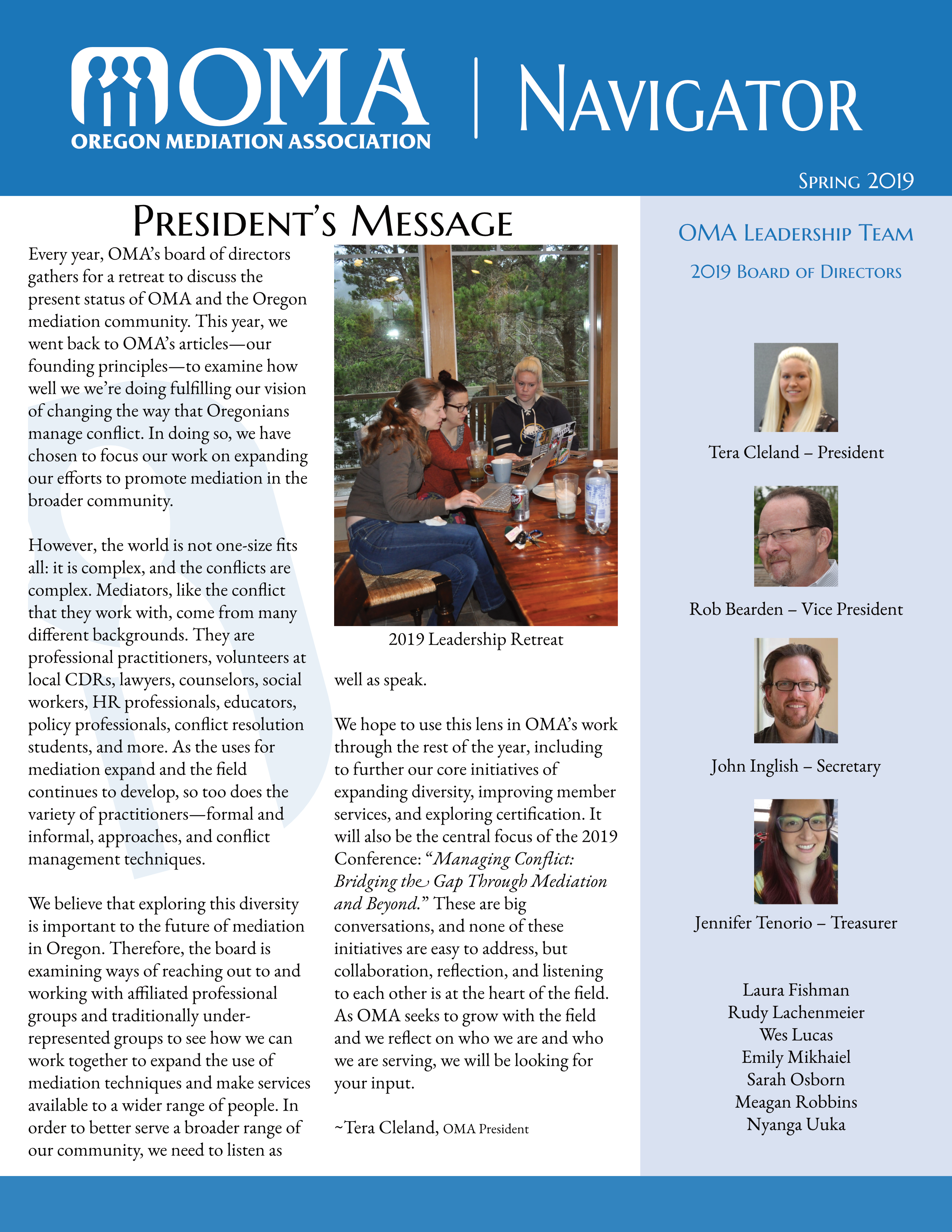
The Spring OMA Navigator is here!

Thanks to all who contributed, and a big thanks to our tireless volunteer, Billy, who made it possible.

Read the latest edition online here.

Filed Under: Uncategorized

The Self-Care Series: Early to Bed

April 9, 2019 by ormediate

How you put yourself to bed and what time you turn off the lights makes a huge impact on your mood, energy, health, and longevity. Yet, our culture stigmatizes sleep, glorifying those who can push through an all-nighter and dismissing those who prioritize sleep as lazy or unmotivated.

Are you getting less than seven hours of sleep most nights of the week? Are you a night owl who stays up into the wee hours of the night? Do you have a hard time getting to sleep or staying asleep all night? Do you feel foggy and sluggish when you wake in the morning? Would you like to feel bright, clear, and energized when you wake each day?

If you’ve answered yes to any of these questions, you may want to create the habit of Early to Bed.


Sleep is Essential

Humans are not like the owls, or cats, or bats that sleep in the day and are awake at night. We are physiologically programmed to do the opposite. This phenomenon has been understood for thousands of years and was recently validated by modern science.

  • Ayurveda and Chinese Medicine are two ancient sciences that are based on the natural cycles of nature.
  • Your great grandmother intuitively knew it too and may have taught you “early to bed and early to rise” as a rule for good living.
  • In 2017, the Nobel Prize in Medicine was awarded to scientists who identified the molecular mechanisms that govern the circadian rhythm.

Also in 2017, neuroscientist Matthew Walker authored, “Why We Sleep: Unlocking the Power of Sleep and Dreams” to explain the importance of sleep and convince us all to prioritize rest. “There does not seem to be one major organ within the body, or process within the brain, that isn’t optimally enhanced by sleep (and detrimentally impaired when we don’t get enough),” Walker writes.

The list of impairments caused by sleep deprivation (i.e. less than seven hours per night) is long and far-reaching. A few of them are illustrated in this infographic, and include: food cravings, lower immune function, increased cancer risk, high blood pressure, emotional instability, depression, anxiety, and irritability.

Whether you listen to the ancient sages, to your sweet grandma, or to the hard science, the truth about sleep is clear. Sleep is essential.

How to Go to Bed Early

Last month we talked about eating an Earlier Lighter Dinner. This is the habit of eating your last meal of the day by 6pm so you have time to completely digest your food before bedtime. The habit of an Earlier Lighter Dinner sets you up for the habit of Early to Bed because your body won’t be working on digesting food while you sleep and it can do what it supposed to be doing overnight: restoring, detoxifying, and resting.

If you live by your natural circadian rhythm, that means you go to bed – or at least start winding down – when the sun goes down. This is the time of day when your energy is naturally waning and getting you ready to rest. Knowing you need to get at least seven hours of sleep, count backwards from you waking time and you’ll find your bedtime. It’s probably around 10pm.

If you’ve had an Earlier, Lighter Dinner, you’ve already taken a step toward winding down for an early bedtime. Since you’re not eating late, you have time in the evening to:

  • Relax, do some light activity, and allow yourself to feel tired.
  • Finish your work and turn off your devices at least an hour before bedtime.
  • Take a bath, read, or meditate.

All of these activities send the signal that it is time to get quiet and go to sleep. They will teach your body and mind how to go to bed early.

Knowing and Doing are Different Things

When we know the impact of sleep deprivation and we know that we are naturally wired to sleep at least seven hours a night, Early to Bed is a no-brainer. But the culture we live in, and the evening habits most of us have, don’t support good sleep.

  • If your life is full, you may feel like sleeping less is the only way to get everything done. This may FEEL true, but is it? What is the cost of burning out or getting sick from lack of sleep? Are you able to be your best without proper rest? Consider what activities and tasks you could cut back on or quit so you have time to get the sleep you need.
  • If you are a night owl, you may think it’s impossible to go to bed by 10pm. It will take some time to adjust to an earlier bedtime. Do this by going to bed 15 minutes earlier this week, then 15 minutes earlier next week, and so on. Make the change gradually and you’re more likely to stick with it.
  • If your friends and family don’t go to bed early, you’ll have to make tough decisions and decline some invitations. Prioritize going to bed early MOST nights. Choose wisely and enjoy fully the occasions you do attend. As you begin to feel the effect of adequate sleep, it will be easier and easier to choose your well-being over a night out.

Adopting the habit of Early to Bed will have short and long-term impacts on your life. You’ll lower your risk for disease, and you’ll be less prone to accidents. Being well-rested means you’ll wake up with more energy and have better focus to do your work each day. You’ll be more emotionally stable, which can lead to gains in your work and personal relationships, confidence, and self-esteem.

What will be your simple step toward living in sync with nature and adopting the habit of Early to Bed?

About the Author

Kirstin Pinit teaches the art of self-care through creative, engaging, and practical habit-change programs. She is a certified coach and yoga teacher and consults with cities, communities, companies, and groups on behavior-change programs and strategies. Learn more about her work at www.kirstinpinit.com.


Filed Under: Uncategorized

Get Involved!

March 18, 2019 by ormediate

OMA is looking for a few good men and women to help fill vital volunteer roles. Commitments and projects vary, so no matter your interests, there is some way to get involved!

OMA’s Member Services Committee has 4 seats to fill. These are volunteer positions that meet four times a year to discuss member benefits, and plan opportunities for member engagement with outside communities.

Specifically, the Committee is looking for members with any of the following:

  •       Human Resources experience,
  •       affiliation with the ADR section of the OSB,
  •       affiliation with a CDRC, or
  •       a commitment to neighborhood conflict.

Interested individuals should contact the office no later than March 28th and the Committee Chair will contact you to learn more about your interest.

OMA’s Finance Committee is looking for members to help brainstorm and evaluate how to best maintain and utilize our financial resources.  How do we manage and disburse scholarship funds? How do we best use OMA’s growing reserves? Join the conversation and help us determine a strong financial path forward for OMA!

Tech Gurus Wanted!

We are looking for one or two volunteers to help provide support in two vital tech roles in operations and information management. If you would like to help maintain the WordPress platform for OMA’s website or know about database management, we want to hear from you! Commitment is sporadic, approximately 2-4 hours per month.


Filed Under: Uncategorized

The Self-Care Series: Earlier, Lighter Dinner

March 8, 2019 by ormediate

This month The Self-Care Series will help you feel more energetic and light by getting in touch with the rhythm of nature and experimenting with the habit of eating an Earlier, Lighter Dinner. Adopting this lifestyle habit can go a long way toward improving your capacity to do your work and enjoy your life.

Most Americans tend to eat large heavy dinners. Busy days often include a quick lunch eaten on the go or while working and then a bigger, heavier evening meal after the day is done. Dinnertime is part of the social fabric of our culture. We connect with friends and loved ones over food and drink. We indulge in the name of celebrating a big win or to soothe a challenge.

The problem with this cultural norm is that it is hard on your body and mind!

Eating late in the evening puts a heavy load on your whole system. Instead of resting and rejuvenating while you sleep, the body is still digesting your big meal. Instead of detoxing and removing waste, the whole system is clogged with more material than it can handle.

A heavier, later dinner lifestyle contributes to digestive and sleep issues, low energy, and foggy thinking. It can result in added weight, stiff joints, memory decline, and degeneration of vision and hearing (often considered the inevitable effects of aging).

If you want to feel light and clear in body and mind, eating an earlier, lighter dinner can help.

Living on Mother Nature’s Schedule

Humans are physiologically designed to be active in the daytime and sleep at night. This natural phenomena has been proven by nobel laureates whose research on circadian rhythm explains the molecular processes that sustain life. Ayurveda is India’s “science of life” and provides simple, practical guidelines for living in sync with Mother Nature’s natural rhythms. This ancient wisdom is aligned with the scientific understanding of circadian rhythm.

Ayurveda’s explanation of our internal clock helps us understand that the daytime hours are best for physical labor and exercise. It’s when our digestive “fire” is strongest and our energy is more mental and creative. The nighttime hours are when the body is settling down and preparing for sleep. During sleep, our internal organs are resting and repairing.


Working Against the Clock

Our bodies are remarkable machines that can continue to function even when we live against the body’s internal clock. We fuel up on food and caffeine, catch the second wind, and keep producing long into the night. We can do this occasionally – and sometimes we have to – but over time, this rhythm is not sustainable.

A life of working against the clock is associated with the increasing occurrence of lifestyle diseases that develop over years of poor nutrition, disrupted sleep, and lack of physical activity. Choosing to live in sync with your biological clock is a simple way to feel better and avoid debilitating and hard-to-cure diseases that diminish your quality of life and shorten your lifespan.

Earlier, Lighter Dinner Basics

When you eat dinner early, you digest your food before you go to bed so your body can rest, restore, and reset overnight. Here’s how:

  • Eat a satisfying lunch including protein and healthy fats. Avoid afternoon snacks.
  • Eat your last meal of the day by 6pm. Choose simple foods that are easy to digest.
  • Do not snack after dinner. Brush your teeth to avoid the temptation to nibble.
  • Slowly adjust your mealtime by 15 minutes each week until you are eating by 6pm.
  • Make a weekly meal plan so you always know what’s for dinner.


Adopting the habit of an Earlier, Lighter Dinner has many benefits. You’ll free up your evening for other nourishing activities like connecting with friends and family. You’ll make it easier for your body to rest and restore itself overnight. You’ll set yourself up to be clear and energetic the next morning. You’ll keep your body lighter and will experience fewer aches and pains as you age.

What will be your simple step toward living in sync with nature and eating an early, light dinner?

About the Author

Kirstin Pinit teaches the art of self-care through creative, engaging, and practical habit-change programs. She is a certified coach and yoga teacher and consults with cities, communities, companies, and groups on behavior-change programs and strategies. Learn more about her work at www.kirstinpinit.com.


Filed Under: Uncategorized

  • « Previous Page
  • 1
  • …
  • 7
  • 8
  • 9
  • 10
  • 11
  • Next Page »

News and Announcements

  • Join The CSMP Steering Committee
  • Register for OMA’s 39th Annual Conference!
  • Volunteer with OMA!
The Oregon Mediation Association

Welcome to OMA

Conflict is a natural part of life. Managed intentionally, conflict can positively transform lives and relationships. Mediators are trained to understand the source of conflicts and identify a path away from adversarial positions toward positive growth and change. Mediators create a safe space to have difficult conversations. The Oregon Mediation Association works to build greater awareness of mediation as a useful conflict management tool.

OMA in a Nutshell

OMA is a network of practitioners and supporters who are committed to the development, support and advocacy of mediation in Oregon.

Mission

OMA's mission is to help Oregonians transform the way they confront and resolve conflict in their personal lives and in their communities.

Contact Us

Main: 503-208-4309
OMA@ORMediation.org
620 SW 5th Ave Ste 900
Portland, OR 97204

JOIN OMA

Click to Join! We welcome you to our vibrant community.

© Copyright 2010-2026 Oregon Mediation Association · Site Created and Maintained on the Genesis Framework · Powered by WordPress